Cloud contrast — what's going on with the bright flat region
2026-06-28 · standalone three.js port · measured on the real GPU (RTX 4070 Ti SUPER), the CD's exact screenshot camera (pos 50050,43042,11281 · yaw −61° · pitch −36°), frozen + phase-matched · all candidates are flagged params on the most-liked checkpoint (default unchanged).
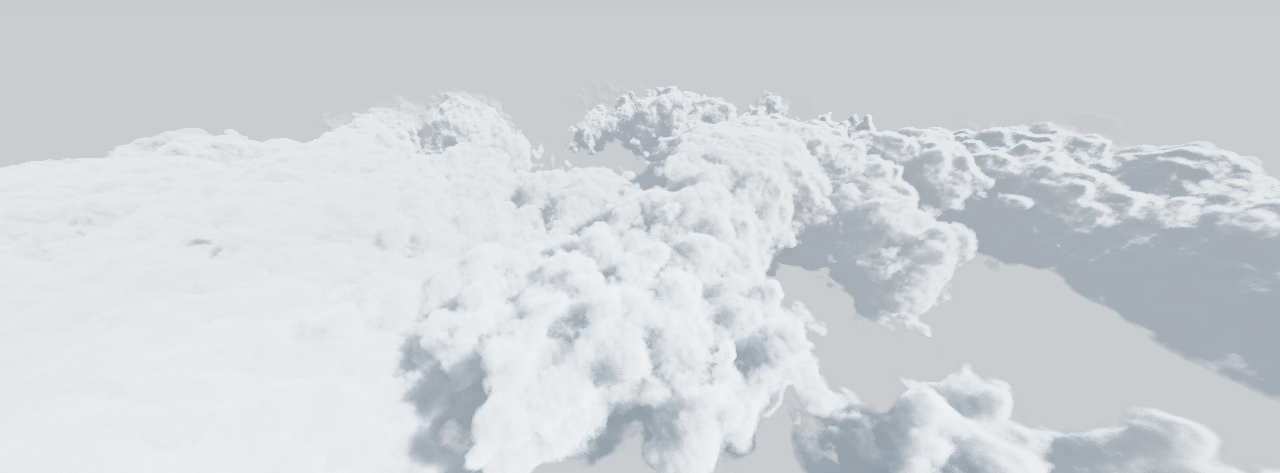
The finding (measured, not vibes). It is not hard clipping — both regions are 0.0% blown at the current setting. The red region is dead because its local contrast collapsed to 0.9 and its value range to ~5 — a uniform bright wall with no dark anchor. Green carries 5× the local contrast and a dark anchor down at 176 → it reads as form. "Blown %" alone would pass both; only local-contrast separates them — the eye-vs-metric lesson.
The honest reframe
The red flat top cannot be turned into the green billows by a knob — that region is a coverage-saturated flat crust (geometric), not a shading bug. I built and tested a "restore far-field detail" fix on that theory; it measured a no-op (red byte-identical) and was reverted. The win available now is: deepen the form in the billows (the part you love) and optionally recede the bright wall. Truly restructuring the red crust into real cloud mass is a separate, bigger move.
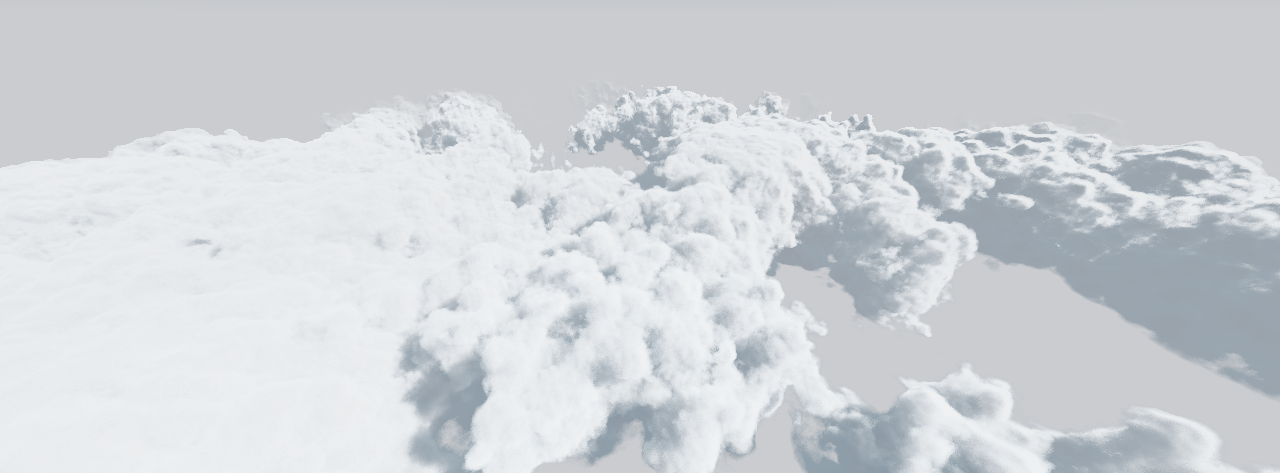
See it yourself — drag to wipe
Same camera, same cloud, frozen. Left of the handle = one setting, right = the other.
Base ↔ sk14 the recommendation (math-safe form)
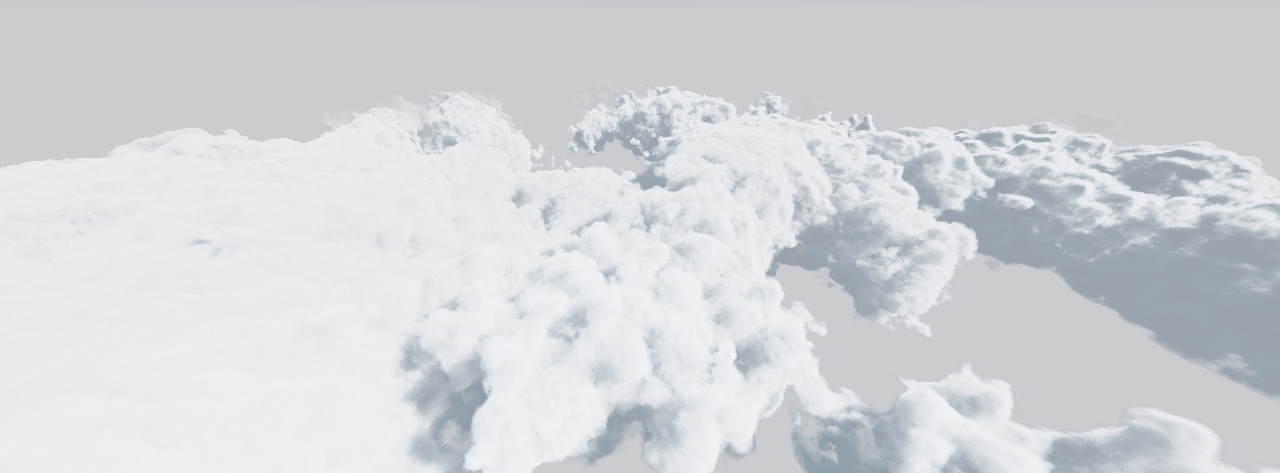
Base ↔ sh18 dramatic — flagged (ring/grain risk above sk14)
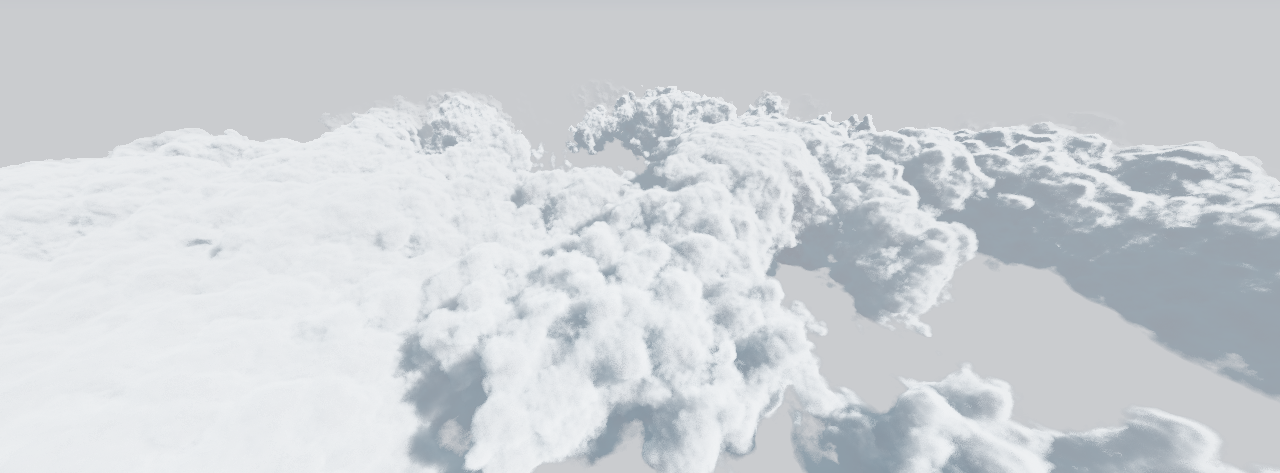
The full range
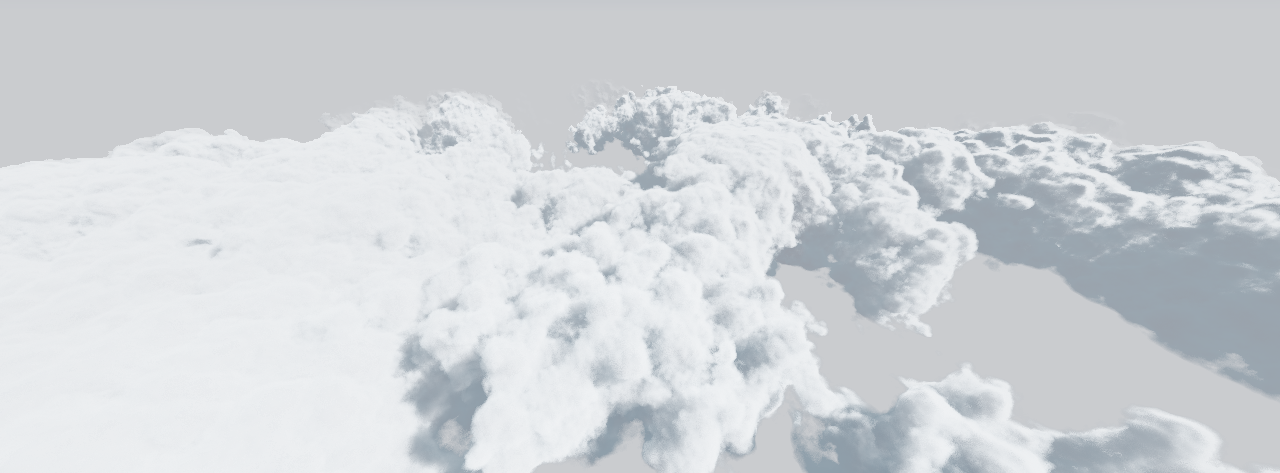
Measured (real GPU, frozen, display sRGB)
| variant | RED top — local contrast | RED — mean L | GREEN billows — local contrast | GREEN — value range | blown |
|---|---|---|---|---|---|
| base (current) | 0.9 | 235.6 | 4.5 | 63.2 | 0.0% |
| sk13 | 1.1 | 234.9 | 5.5 | 70.4 | 0.0% |
| sk14 (rec) | 1.1 | 234.7 | 5.9 | 71.8 | 0.0% |
| sk14 + fog 0.42 | 1.1 | 231.7 | 5.5 | 64.3 | 0.0% |
| sh18 (flagged) | 1.4 | 233.6 | 7.1 | 75.1 | 0.0% |
Note the red top barely moves on any setting (1.1 at best) — confirming it's geometric. The gains land in the green billows (the form you love): +31% local contrast at sk14, +58% at sh18.
The two neutral teams (blind / two-directional — no poison)
Math-checker (the shader math)
- Default path byte-for-byte untouched — both levers are flagged params (
?sk=,?fog=); the most-liked checkpoint is unchanged unless set. - The form gain is real — deeper self-shadow separates the lit shell from the already-dark core (that's the local-contrast lift). It corrected my premise: thin regions are affected most, not least.
- Sticker-ring risk grows super-linearly — edge/core contrast ratio 7.7× → 26× → 40× from sk 10k→16k→18k. Safe entry ≈13–14k; a multi-angle ring check is required before going higher. (No ring observed by either critic at these levels.)
- Fog counter-effect — it blends in linear (sound) but lifts dark cores below sky-horizon luminance (0.408), partly cancelling the form. Keep fog ≤0.45.
Two blind critics (relabeled A–E, told nothing)
- Both ranked the current base LAST — "brightest + flattest", "closest to a blank white wall". Any of the changes beats it. (This validates the catch.)
- Deeper self-shadow = more dimensional, 3D form — both saw the billows gain rounded depth.
- No sticker-rim, no blowout in any variant — both checked the silhouette explicitly; every edge is darker than its interior (correct).
- They split on two things (a real taste fork for the CD's eye): (1) fog — one found it airier/easier on the eyes, the other found it flattened the form; (2) one flagged possible grain on lit faces at the most aggressive deep-shadow (sh18) — the other measured it as structured cloud detail, not noise. → resolved by a motion check; the rec is capped at sk14 where it's mildest.
Recommendation
Bake sk = 14000 as the candidate — it gives the billows real form (the part you love) inside the math-safe range, with no ring and the mildest grain, and leaves the (geometric) red crust honest. Optional: a gentle fog=0.42 to take the worst off the bright wall — your eye's call (it costs a little form).
Open verify before it becomes the default: a motion-gif pass (resolve the grain question in motion) + the math team's multi-angle ring check. And the real red-region fix — a density restructure — is the next bigger move.
Fly it yourself (live, on your phone)
The most-liked checkpoint with each setting applied — WASD/drag to move, it's the real renderer:
- base (current most-liked)
- sk14 — the recommendation
- sk14 + fog
- sh18 — dramatic, flagged
Method: qa/tools/_ablate-cap.mjs (his-camera frozen capture) · qa/tools/_region-measure.py (local contrast) · two neutral Agent teams · this page. Findings folded into cd-twin/ (the CD-eye corpus). The CD's eye is the verdict — this is a pre-screen.